Perimenopause Rage Is Real: How Reiki Can Create Space to Pause, Rest and Reconnect
Okay, I need to talk to you about perimenopausal rage—because sometimes it is not that everybody suddenly became unbearable.
Although…why *are* they chewing that loudly?
For some of us, the hormonal shifts of perimenopause can bring irritability, disrupted sleep, anxiety, mood changes, and emotions that feel as though somebody turned the volume all the way up.
One minute, you are fine. The next minute, a cabinet has been left open and now you are questioning every decision that brought you to this exact moment.
The anger is real. You are not imagining it, and feeling it does not make you a bad person.
But rage does not feel good in the body. You get angry. Your jaw tightens, your shoulders rise, your breathing changes, and your whole body braces. That tension creates more stress, the stress makes everything feel even louder, and suddenly you are caught in a loop.
You are tired. Your body is tired. And everybody probably needs to give you a little room.
Why Perimenopause Can Make Everything Feel So Intense
“Perimenopause rage” is not a formal medical diagnosis, but the experience women are describing is very real.
Hormonal fluctuations during the menopause transition can affect mood. Sleep disruption, night sweats, anxiety, changing responsibilities, and the pressures many women carry in midlife may add even more strain. According to the American College of Obstetricians and Gynecologists, approximately four in ten women experience mood symptoms during perimenopause that resemble premenstrual symptoms, including irritability, low energy, difficulty concentrating, and tearfulness.
That does not mean every moment of anger is caused by hormones—or that legitimate frustration should be dismissed as “just perimenopause.” Sometimes you are angry because something is genuinely wrong. Sometimes a boundary has been crossed. Sometimes you have been overextended for years.
But when your reactions feel unfamiliar, disproportionate, or difficult to control, hormonal changes and disrupted sleep may be part of the picture.
Understanding that can replace shame with curiosity.
Instead of asking, *What is wrong with me?* you can begin asking, *What is happening in my body—and what kind of support do I need?*
Where Reiki Can Fit Into the Conversation
This is where Reiki can be a beautiful, gentle form of complementary support.
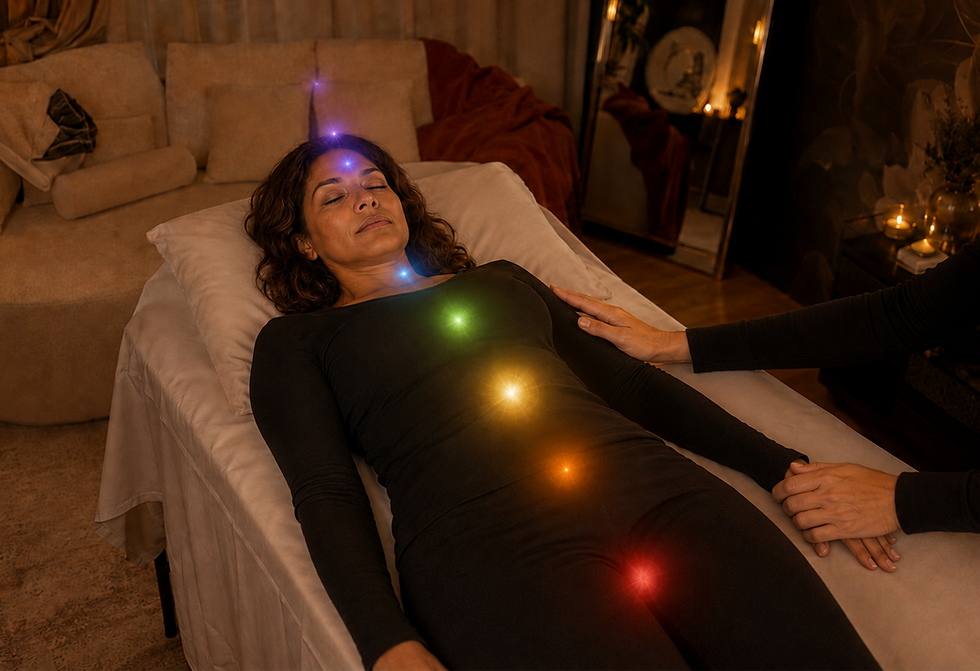
Reiki is an energy-work practice. During a session, a practitioner places their hands lightly on—or just above—the body with the intention of creating a calm, restorative space.
For the woman receiving it, the most important part may be very simple: you get to stop.
You stop doing, fixing, organizing, anticipating, remembering everything for everybody, and holding the entire world together with one bobby pin.
You get to lie down and receive.
There is no appointment to coordinate, no problem to solve, and no one asking you where they left the thing that is directly in front of them. For that stretch of time, you are not responsible for anyone else’s comfort.
The room is quiet. You are fully clothed and supported on a comfortable treatment table. You are invited to breathe, soften, and notice what it feels like to be cared for without having to earn it first.
Reiki does not regulate hormones or treat the medical causes of perimenopause. What it can offer is an intentional pause—a ritual of attention, rest, and connection during a season when many women feel disconnected from themselves.
What Do Chakras Have to Do With Anger?
Now, let’s talk chakras.
Within chakra traditions, anger and rage are often explored through the solar plexus chakra. This is the energy center associated with personal power, confidence, control, self-worth, and boundaries.
Using that spiritual framework, the question may not simply be, *Why am I so angry?*
The deeper questions might be:
- Where do I feel powerless?
- Where am I overextended?
- Where have I been saying yes when my entire spirit meant no?
- Where am I carrying responsibilities that were never mine?
- What boundary needs to be communicated, strengthened, or restored?
Because sometimes the rage is not random. Sometimes it has information.
The root chakra may enter the conversation when you feel unsafe, unstable, unsupported, or constantly on alert. The sacral chakra may offer another lens when your emotions, creativity, sexuality, pleasure, or relationship with your changing body feels unsettled.
Chakra language is a spiritual framework—not a medical diagnosis. We are not blaming your chakras for everything while ignoring your hormones, your health, or the possibility that you need medical treatment, mental-health support, actual rest, and more help at home.
This framework is not intended to prove what caused an emotion. It simply creates another way to become curious about what that emotion may be communicating.
When Your Energy Feels Heavy, Wired or Stuck
What energy workers sometimes describe as dense, heavy, or “lower-vibrational” energy can be experienced as exhaustion, emotional reactivity, negative thought loops, or a feeling of being stuck and unable to settle.
In ordinary language: tired, wired, irritated, and somehow still expected to remember what everybody wants from the grocery store.
During a Reiki session, there is nothing you need to perform. You do not have to arrive calm, spiritual, positive, or perfectly open to the experience. You are allowed to arrive exactly as you are—even if exactly as you are is aggravated and one inconvenience away from moving alone into a cottage in the woods.
The session is not about declaring certain emotions “bad” and trying to force them away. Anger can be protective. It can reveal a need, a limit, an injustice, or a truth you have been avoiding.
The invitation is to create enough quiet that you can listen without being completely consumed by it.
What Happens During a Reiki Session?
You remain fully clothed and rest comfortably while the practitioner works around different areas of your body. They may hold their hands just above you or use very light touch—with your permission.
Every session is different.
You might notice warmth, coolness, tingling, gentle pulsing, or a subjective sense of energy moving. You may see colors or images, feel emotions rise and pass, or drift into that lovely space between awake and asleep.
You might also feel nothing dramatic at all—and that is completely okay.
This is not a competition. You do not need to see your ancestors, levitate, or receive next week’s lottery numbers for the session to be meaningful.
Afterward, some people report feeling calmer, lighter, clearer, or more grounded. Some feel sleepy or emotionally tender and want quiet time. You may simply notice that you can take a deeper breath, your shoulders have dropped, and everything no longer feels quite so urgent.
These are personal experiences, not guaranteed outcomes. A session can still be valuable as intentional rest even if there is no dramatic sensation or transformation.
What the Research Says About Reiki
It is important to be honest about what we know and what we do not.
The National Center for Complementary and Integrative Health, part of the National Institutes of Health, states that Reiki has not been clearly shown to be effective for any health-related purpose. Studies examining Reiki for pain, anxiety, depression, and other concerns have generally been inconsistent or of limited quality. There is also no scientific evidence establishing the energy field proposed within Reiki traditions.
Reiki has not been shown to have harmful effects, but it should not be used to postpone or replace appropriate medical or mental-health care.
That means Reiki is not a cure for perimenopause, a treatment for hormonal imbalance, or a substitute for speaking with a qualified healthcare professional.
It can be chosen as a complementary personal practice—one that offers intentional rest, gentle attention, spiritual reflection, and a pause long enough to hear yourself again.
You Deserve More Than Being Told to Calm Down
The goal is not to shame your rage or force it to disappear.
The goal is to understand what is happening, give your body and spirit meaningful support, and help you find your way back to yourself.
That support may include a clinician who understands perimenopause, appropriate treatment for hormonal or mental-health symptoms, better sleep care, stronger boundaries, movement, nourishing food, honest conversations with the people you love, and complementary practices such as Reiki if they feel meaningful to you.
If your mood changes feel intense, persistent, frightening, unsafe, or disruptive to your daily life, please speak with a qualified healthcare or mental-health professional. Seek urgent help if you are concerned that you may harm yourself or someone else.
You do not have to white-knuckle your way through this transition. You do not have to apologize for needing help, and you do not have to accept being dismissed.
You are not “too much.”
You are going through something—and you deserve real support while you move through it.
Sometimes you were not too much at all.
Sometimes you were under-supported.
---
A Note From Alexandra
I share this perspective as a Reiki practitioner, an esthetician who has spent more than 25 years listening to women speak honestly in my treatment room, and a woman navigating perimenopause herself. This article is educational and does not provide a diagnosis or replace individualized medical or mental-health care.


Comments